Critical Report Reveals Up to 40% of SAPOL Officers Unavailable for Frontline Duties
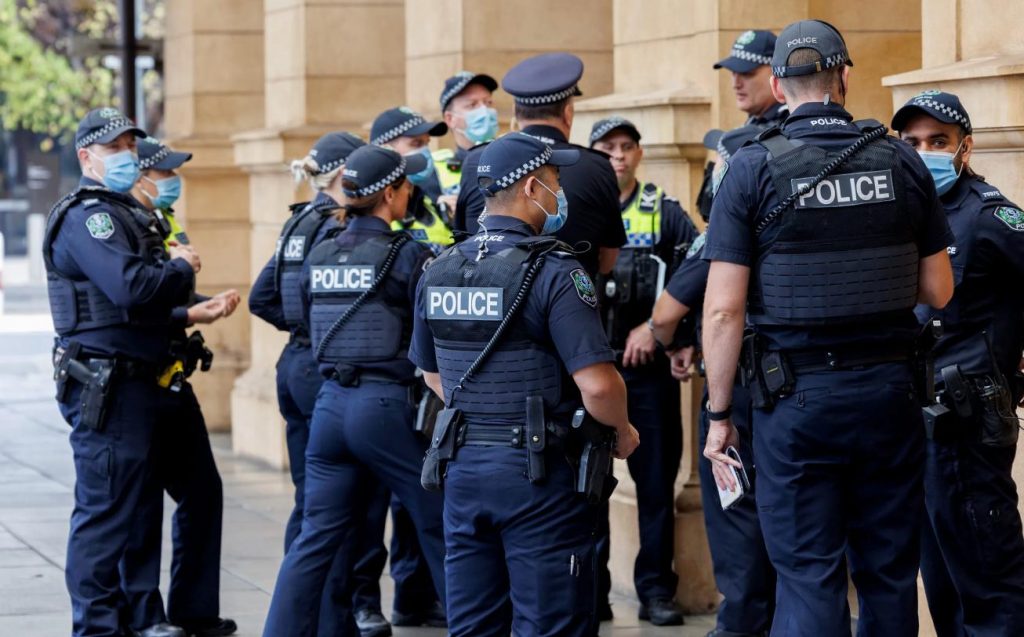
SAPOL claims it doesn't have enough frontline officers, but when cowardly police commissioner Grant Stevens had to appear in court to face questions about his role in the Covid scam, a busload of cops were miraculously available to hold his hand in case protestors said hurty words and waved signs at him.
Up to 40 per cent of metropolitan SA Police officers are unavailable to respond to frontline incidents, a critical report into the force’s district policing model has found.
The independent review of the controversial model found the system was “no longer sustainable in its current form”, highlighting a major shortage of deployable frontline officers and growing delays in investigative work caused by mounting administrative burdens.
The extended report, carried out by professional services firm BDO, visited every police station in metropolitan Adelaide more than once, engaging with more than 900 SAPOL members in its four metropolitan districts.
The district policing model, introduced in 2018, has been blamed since its inception for increased workloads on officers, leading to mass exodus.
One of the primary findings of the BDO report was that while police appeared, on paper, to have a healthy number of frontline officers, a significant proportion of the workforce was unable to respond to incidents.
“There is a substantial gap between ‘operational establishment’ (the number of designated staff available on the organisation chart) versus ‘actual deployable strength’ (the number of staff who are actively available, qualified and unrestricted in their ability to perform operational duties at any given time),” the report said.
“Analysis of case studies highlighted that this gap typically ranges from 30 to 40 per cent, particularly affecting frontline response.”
The force has relied on overtime and voluntary return-to-service arrangements to bridge the gap, but even then frontline staff delivered only 65 to 75 per cent of their total expected hours over the past five years.
The review found the already stretched workforce was being further burdened by a dramatic rise in administrative workload – driven in part by new technology – which was choking the system and creating widespread investigative backlogs.
A snapshot of investigation workloads found in August 2025, 61.55 per cent of investigations were overdue against their allocated due date, including 71 investigations delayed by more than 100 days.
While crime occurrence had grown by only six per cent since 2019-20, tasks linked to those crimes had risen by 30 per cent.
“The changes reflected “greater administrative complexity and the additional effort required to manage and finalise cases,” the report said.
BDO warned that while new technology had improved access to information, it had also “increased administrative burdens” and at times “hindered real-time responsiveness” on the ground.
The report said “without significant further investment and change, the district policing model is no longer sustainable in its current form”.
“SAPOL now stands at a pivotal moment,” it said. “This is an opportunity for collective action, to honour the legacy of service, embrace the challenges ahead, and build a system of policing that is adaptable, trusted, and fit for the future to sustainably enable safer communities across Adelaide and South Australia.”
Police Commissioner Grant Stevens has previously said the “review was designed to be a catalyst for improvement” and would support programs already in place to “reduce demand and streamline processes and reporting”.
Mr Stevens has announced changes to provide relief to frontline policing, including giving officers mobile phones to complete their work on scene, reducing unnecessary reporting, enhanced face-to-face training for sergeants and senior sergeants, stopping traffic benchmarks and creating 24/7 district duty inspector positions in every district.
Stevens is a failed commissioner who stubbornly championed the DPM long after it was an obvious disaster. Yet he remains police commissioner, receiving a huge and totally undeserved $700,000 of taxpayer money annually.
The hack responsible for implementing Stevens’ DPM was John De Candia. Just like Stevens, he has not been kicked out of SAPOL, but has instead been rewarded for his sheer incompetence. He was recently appointed to the role of assistant police commissioner.
Sources
Critical report reveals up to 40 per cent of SA Police officers unavailable for frontline duties. The Advertiser.



the big question to be asked here is ‘what does the Minister of Police have to say about this dysfunctional organisation where it is likely that, according to a recent survey, 50 per cent of the current staff will NOT be there in 5 years’.
If the Minister is being briefed accurately, is the Minister completely happy with the integrity of SAPol and particularly the leadership group?
It is said that an organisation takes on the personality of the CEO and in this particular case the CEO is being worshipped daily by the underlings who are blindly obedient.