State Coroner orders SA Police to hand over secret files on dead Sergeant Russell Peter Nash’s bullying claims
The Police Commissioner’s refusal to release secret files in a bullying probe linked to a sergeant’s suicide has backfired, with the State Coroner David Whittle now forcing SA Police to hand them over.
Police Commissioner Grant Stevens – as the SA Police authority responsible for deciding whether the organisation will release internal investigation documents – had previously refused to provide the records to the Coroner’s Court by invoking controversial secrecy powers.
State Coroner David Whittle in April ordered a summons be sent to SAPOL to release the internal inquiry material to the court.
It came after Coroner Whittle rejected Stevens’ submissions that the production of the documents would be unfair and amounted to a “fishing expedition”.
What have you got to hide, Grant?
Stevens’ submissions also accused counsel assisting the coroner of taking an “inappropriate” approach to the inquest that amounted to a quasi-prosecution of the superior officer, which Whittle rejected.
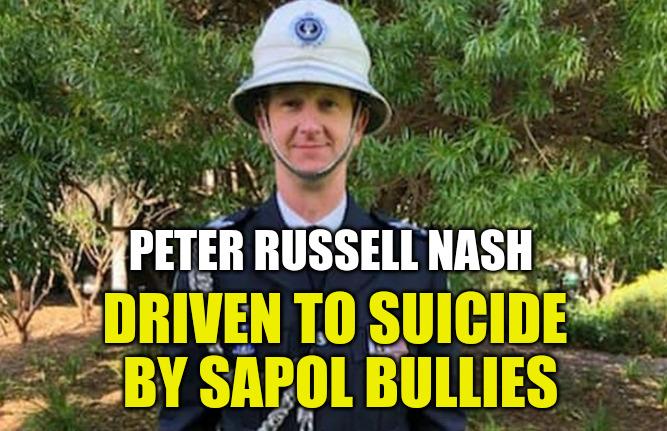
The court has been hearing evidence in relation to the death of Sergeant Russell Peter Nash, who took his own life in 2021 while serving as the bandmaster in the SA Police band.
The inquest has been told that shortly before his death, Sergeant Nash, with the assistance of a lawyer, formulated the foundations of a complaint of bullying and harassment against then-chief inspector Cameron Devey, who is now the deputy chief officer of the Metropolitan Fire Service.
After he died, Sergeant Nash’s direct boss made a complaint of bullying and harassment which she claimed had contributed to his death. Once the court became aware of a SAPOL internal inquiry into the allegations, it sought documents relating to it, at which point Stevens “formally declined to provide those documents to the court for any purposes,” Mr Whittle said.

Sergeant Russell Nash took his own life in December 2021. Picture: Supplied
Under the Police Complaints and Discipline Act, information pertaining to internal investigations is kept secret, with only the Police Commissioner, as well as the Independent Commissioner Against Corruption and the Office for Public Integrity, empowered to release information at their discretion. Courts can overrule these decisions.
The circumstances of the officers’ absences are not linked to each other or the coroner’s inquiry.
In relation to Sergeant Nash’s death, counsel assisting applied to the court for an order to be made compelling Stevens to produce the internal investigation documents, which the commissioner, through his counsel, opposed.
In making his ruling on the application on Thursday, Whittle said “a great deal” of Stevens’ submissions argued that counsel assisting took an “inappropriate” and biased approach to the inquest.
However, Whittle said such assertions had no merit, and counsel assisting’s robust exploration of the bullying and harassment allegations were appropriate in the case.
“It is unfortunate that this difference in philosophical approaches and what might be perceived as the commissioner’s desire to have a less robust process has made its way into formal submissions,” he said.
“All counsel ought to consider very carefully whether there is any actual impropriety to be alleged before making personally directed comments and observations about their opponents.”
Whittle said Stevens’ “criticism of those assisting by the vigorous testing of evidence is inapt and distracts from the substance of the evidence procured”.
He also rejected Stevens’ submissions that the inquest was effectively a “quasi-prosecution” of Devey.
“While I have no doubt that Mr Devey may have found the process of giving evidence in the inquest difficult, apart from the obligation on a witness to answer difficult questions under oath, the coronial jurisdiction itself is deprived of all distinctive qualities of a prosecutorial process,” Mr Whittle said.
“The submissions made on this topic effectively amount to a complaint that a witness felt as though he was being prosecuted while under questioning and because issues relating to his actions were being explored during the inquest.
“I should think is not an uncommon phenomenon, with many witnesses undoubtedly reporting this feeling following the conclusion of their evidence.”
Mr Whittle also said he did not consider the provision of the documents could prejudice any investigation of crimes “as the complaint did not involve issues pertaining to criminal operational police work”.
He further rejected Mr Stevens’ submissions that the application amounted to a “fishing expedition”.
“The Commissioner of Police asserted that the purpose for the application is ‘to see if there may exist material that could further the position (counsel assisting) adopted in this inquiry where he openly sought to impugn the credibility of Mr Devey’,” Mr Whittle said.
“Putting aside the inappropriateness of the use of the word ‘openly’ and the negative connotations that phrase tends to convey, I am unable to accept that characterisation of the application, and it is unclear to me from where in counsel assisting’s submissions, in which he explains the purposes for seeking the order, that assertion was taken.
“I have been asked to determine during the inquest whether there was or was not bullying and harassment of Mr Nash in the lead-up to his death. The fact that witnesses have been spoken to about this precise topic takes the application outside of what could reasonably be described as a fishing expedition.”
Whittle emphasised he did not know what the internal investigation documents would reveal, and “it may be that the investigation reveals facts favourable to the position taken by the Commissioner of Police during the inquest, or facts that are adverse to that position”. “ … their continued secrecy has the capacity to lead the court to potentially erroneous findings, which might be unfair to any or all of the witnesses,” he said.

Commissioner Grant Stevens. Picture: Tom Huntley
Mr Whittle went on to say that “identifying any improvements to bullying and harassment investigations is a matter which has the capacity to prevent further deaths”.
“That is, if there are proper procedures in response to such allegations, it might have the capacity to lead to a complaint in future that is responded to in a manner that leads to the complainant not making the decision to take their own life,” he said.
Mr Whittle stressed he was not critical of Mr Stevens’ decision to withhold the documents, acknowledging that he exercised a discretion available to him.
“I merely observe that the result of the exercise of the discretion in the manner he decided has a particular result which impacts on the evidence available to the court,” he said.
Whittle made an order that a summons to produce the SAPOL internal investigation documents be issued “with a short time frame for a response”.