Grant Stevens has ANOTHER hissy fit – attacks State Coroner for refusing to go along with SAPOL’s anti-transparency agenda
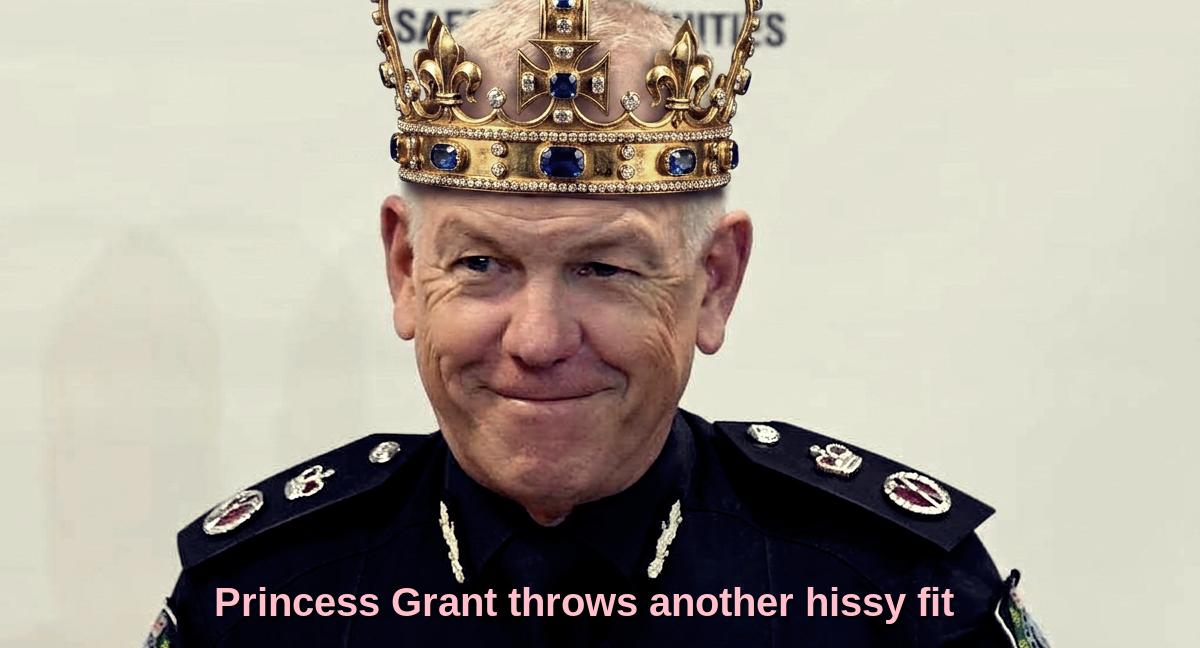
South Australia’s police commissioner, Princess Grant Stevens, is up to his old tricks again.
The bad-tempered, criticism-intolerant Stevens has accused the State Coroner of acting unlawfully by exposing the mere existence, and limited details, of a secret police investigation into alleged workplace bullying.
Coroner David Whittle has vehemently rejected the assertion, saying the court’s authority trumps police secrecy laws.
Police Commissioner Grant Stevens has claimed, through SA Police lawyers, that Mr Whittle acted unlawfully when he published on the Courts SA website in April a ruling on whether confidential internal inquiry documents should be handed over to the court as part of an inquest into the suicide of a police officer.
“In correspondence directed to me and in oral argument, the Commissioner suggested that it was unlawful for me to have published my earlier ruling, as doing so would breach (section) 46 of the (Police Complaints and Discipline Act),” Mr Whittle wrote in new court documents published online.
Section 46 bans the publication of information relating to internal investigations unless authorised by the Police Commissioner or by a limited number of other statutory bodies.
The maximum penalty for breaching this section of the act is a $150,000 fine for a company and $30,000 for an individual.
However, there is no suggestion Stevens is seeking to take action against the Coroner.
The April ruling came after Stevens had previously refused to provide the requested internal inquiry documents to the court, citing other secrecy provisions within the PCDA which give him authority over deciding whether information pertaining to in-house investigations will be released.

Russell Nash playing his first gig with the blues band. Picture: Supplied by family.
Mr Whittle was then asked by counsel assisting to make an order forcing SA Police to give the documents to the court so they could be examined as part of an inquest into the death of Sergeant Russell Peter Nash, who took his own life in 2021 while serving as the bandmaster in the SA Police band.
The court had previously heard that shortly before he died, Sergeant Nash had been working on a formal complaint of bullying and harassment against a higher-ranked officer.
The court was also told that Sergeant Nash’s direct boss, who was not the superior officer in Sergeant Nash’s grievance, lodged a complaint of bullying and harassment, which she claimed had contributed to Sergeant Nash’s death.
It was this information that alerted the inquest to the existence of the internal investigation documents.
Mr Whittle, who had not seen the documents, agreed the files should be provided to the court and made an order for police to produce them.
He published his judgment on the matter on the Courts SA website, in line with common practice.
Following this, Stevens complied with the court summons by handing over internal investigation documents.
However, he subsequently sought ancillary orders from the court requesting that the files provided be kept hidden from witnesses and suppressed from publication – and that parts of the Coroner’s April ruling pertaining to the internal inquiry be redacted.

State Coroner David Whittle has said the case needs to remain open to the public. Picture: Kelly Barnes.
In seeking those orders, Stevens’ lawyers asserted Mr Whittle had breached the PCDA, arguing that the strict confidentiality provisions in the legislation continued to bind the Coroner’s Court – and therefore it was unlawful for the court to reveal details of an internal police investigation in the April ruling, even after the Coroner had lawfully compelled the release of the documents.
Mr Whittle did not agree.
“In my view, (section) 46 has no application to the Coroners Court, nor any other court,” he wrote.
“To suggest that the court would be bound by the Commissioner’s determination about use… would be the first instance of the Commissioner being able to direct the judicial affairs of a court.
“It would mean that any court, including the Supreme Court, would need to seek the Commissioner’s permission to publish information that it had directed be divulged for use in proceedings because the interests of justice could not adequately be served in any other way.”
Mr Whittle largely dismissed Stevens’ applications to redact, restrict, and suppress details of the internal police investigation, however he did allow minor personal redactions and the withholding of a single document relating to an investigation plan.
A police spokesperson said: “SAPOL are aware of the ruling and will not be providing any comment while the inquest is underway”.
Top cop’s bid to hide secret files in officer suicide case rejected
Secret police files detailing internal bullying claims will finally be laid bare after a court threw out a bid to suppress evidence surrounding the suicide of a veteran officer.
The decision by Coroner David Whittle clears the way for crucial documents to be examined in the inquest of SA Police bandmaster Sergeant Russell Nash, who took his own life in 2021.
However, serious questions have been raised by the Coroner over whether further vital information held by SA Police is being withheld, after the Police Commissioner Grant Stevens instructed his legal team to not search for additional material.
Prior to his death, Sergeant Nash was working with a lawyer to prepare a formal bullying and harassment complaint against this superior, then-chief inspector Cameron Devey, who has since resigned to become MFS deputy chief officer.
Devey has denied the allegations.
The court also heard the band’s then-officer in charge, Senior Sergeant Linda Warner, had already triggered an internal investigation into Mr Devey after escalating a complaint to the top brass.
While Stevens initially resisted a summons to hand over the internal files, they were finally surrendered following Mr Whittle’s intervention.
Internal investigations are usually kept hidden, under the Police Complaints and Discipline Act, unless the Police Commissioner makes an exemption.
The Advertiser has received permission to publish the ruling.
Mr Whittle in his ruling said, which has been published online, that said he was concerned the “Commissioner answered the summons with some documents” and “on two subsequent occasions provided further documents”.
“Following concern that further documents were found, I requested that an undertaking be given to ensure that the attention of a diligent lawyer was brought to the task,” he said.
“(But) the Commissioner instructed his lawyers not to give any such undertaking and instead I received a letter which asserted that a personal review of the internal investigation file had been conducted and that there were no further documents to be produced from those files.”
Mr Whittle said this raised questions about whether there were other documents “that fit within the scope of the summons”.
Additionally, when Stevens handed over the material, he launched a legal bid to redact the Coroner’s own ruling, hide the files from select witnesses, and force certain proceedings into a closed court.
Mr Whittle dismissed the majority of the submission, granting only minor concessions and allowing personal details like phone numbers and the investigation plan to be withheld.
Bad-Tempered Stevens Keeps Attacking the Coroner’s Department
This is not the first time Stevens has gotten his frilly panties in a twist over the coroner’s department. In 2019, South Australian Deputy Coroner Anthony Schapel made a request – not a demand, but a simple request – for SAPOL to consider whether it is “reasonable” to always shoot high-risk threats in the torso and instead aim for limbs in some cases.
This caused Stevens to throw a temper tantrum and launch a bizarre and failed legal action. Stevens and the Star Force/Special Operations officer who fatally shot livestock farmer Alexander Peter Kuskoff in 2015 argued Schapel did not have authority to order the discussion.
They asked the Full Court of the Supreme Court to quash the direction because it was “not sufficiently related to a cause or circumstance of Mr Kuskoff’s death”.
Three justices refused to do so, agreeing Schapel’s comment was “neither a finding, nor a recommendation” and the interests of Commissioner Stevens and the officer had not been negatively affected.
The court also dismissed an appeal, lodged by Stevens and the officer, against findings on the moments prior to Kuskoff’s death.
The appeal, which sought to have some paragraphs set aside and replaced, disputed findings on what the officer could see in the period of time during which he fired three times at Kuskoff.
Stevens and the officer argued that particular statements on what occurred were “erroneous” and “unsupported by the evidence”.
They also told the court the officer had been unfairly denied the opportunity to fully respond to allegations before the findings were made.
But the court found the officer was given ample opportunity to give evidence, some of the statements were not open to appeal and, in any event, those statements were consistent with evidence given.
It’s long past time this Stevens clown was thrown out on his arse. While ordinary people struggle with cost of living pressures and increasing crime rates, precious little princess Stevens wastes hundreds of thousands of taxpayer dollars on legal bids to make sure the corrupt, thuggish and totally incompetent SAPOL can keep operating in unacceptable secrecy.
Source
Police Commissioner Grant Stevens accuses State Coroner of acting unlawfully over secret files. The Advertiser.